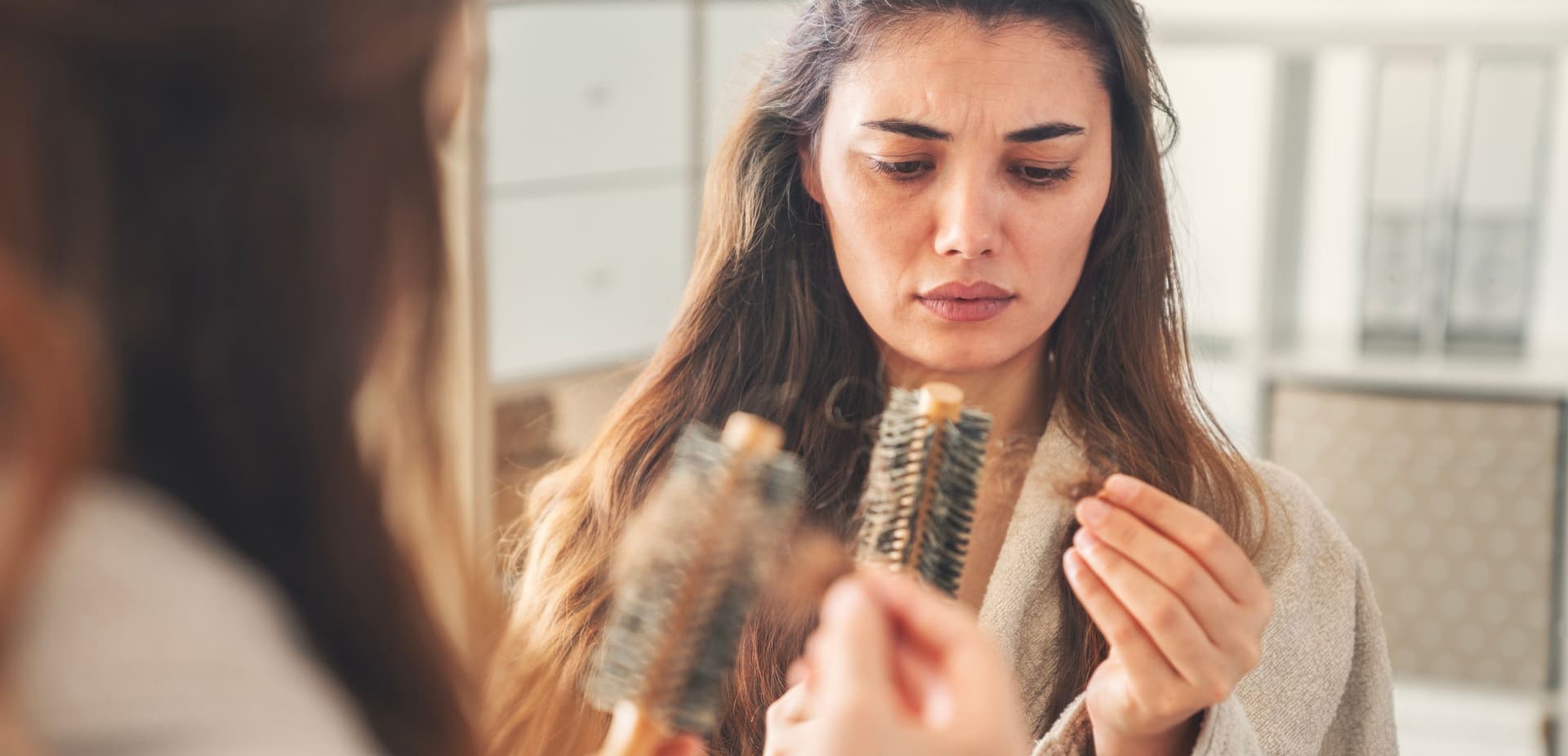
GLP-1 Hair Loss: Why It Happens, and Why My Patients Don't Experience It
Rachel Gunderson, NP · April 8, 2026
Yes, GLP-1 Hair Loss Is Real. Here's What's Actually Causing It.
Let me be clear about the science, because I think it's important to understand what's actually happening.
The hair loss associated with GLP-1 medications isn't caused by the drug itself. It's caused by a condition called telogen effluvium, a temporary hair shedding response triggered by significant physiological stress on the body. When someone loses weight too quickly and drops into too large a calorie deficit, the body interprets that as a famine state and starts making hard decisions about what to keep and what to sacrifice.
I tell my patients directly that if your body is starving and thinks you are in a famine, it sacrifices what is not essential. Hair.
GLP-1 medications work so well at reducing appetite that patients can unintentionally under-eat, lose weight faster than their body can adapt, and trigger exactly this response. The medication isn't the problem. The pace and the nutrition gaps are.
Why My Patients Don't Experience This
When patients come to me and share their fear of losing hair while on their weight loss journey, I respond that I can proudly say that my patients do not get hair loss from GLP-1. I prescribe them correctly so it's not a problem. Let me explain.
The way I approach GLP-1 therapy at Avara Medical is built around one principle: slow, sustainable weight loss that your body can actually keep up with.
I strongly encourage patients to aim for no more than one to one and a half pounds of weight loss per week. That pace keeps the body out of a physiological stress state, preserves muscle mass, and protects hair follicle health. It also happens to be the weight loss that actually sticks long-term.
A mantra that I like to share with my patients is, Slow sustainable weight loss is weight loss you keep off.
This means I sometimes have to push back on patients who want faster results. The GLP-1 medications we use are powerful, and it can be tempting to ride that appetite suppression as hard as possible. Part of my job is making sure that doesn't happen at the expense of your health.

The difference between clinical supervision of a GLP-1
One of the tools that makes a real difference in our program is the InBody scan, a body composition analysis that goes far beyond the scale. Before we start any patient on a GLP-1 program, we do a baseline InBody scan so we can see exactly what we are working with: muscle mass, body fat percentage, water retention, and more.
If a patient is progressing faster than we'd like, or I have a concern that weight loss is happening in the wrong way, we run another scan. That data tells a very clear story. We can show patients exactly when they are losing muscle instead of fat, or when they are pushing too hard too fast. Occasionally, this means we have cut patients off if we are concerned about them.
That level of clinical accountability is what separates a medically supervised program from picking up a prescription and going it alone.
I had a 59 yr old patient at our clinic feeling frustrated after years of being unable to lose weight despite her efforts. After a thorough evaluation, we identified underlying hormone imbalances and created a personalized plan that included hormone optimization and starting tirzepatide. We emphasized a slow, sustainable approach that focused on steady weight loss and gradually increasing her activity level. Over the course of 15 months, she lost 66 pounds, maintained her muscle mass and experienced no hair loss, achieving not only weight loss but a healthier, more sustainable outcome.
What to Watch For If You're Already on a GLP-1 Program Elsewhere
If you are currently on a GLP-1 medication and you are noticing hair shedding, here is what that is likely telling you:
Your weight loss pace may be too aggressive. If you are losing more than one to two pounds per week consistently, your body may be under more physiological stress than it can handle without consequences.
Your protein intake may be too low. When appetite drops on a GLP-1, protein is often the first casualty. Hair follicle health is directly tied to adequate protein, and monitoring this is something I do with every patient throughout their program.
You may not have the right monitoring in place. Hair loss is often a downstream signal of deficiencies that could have been caught earlier with the right testing.

What Utah Valley Patients Ask About GLP-1 Hair Loss
Is hair loss permanent? In most cases, no. Once the physiological stress is resolved and nutrition is restored, the hair growth cycle typically normalizes. But preventing it from happening in the first place is always preferable.
Can I still lose weight at a slower pace? Absolutely. In fact, patients who lose weight slowly and sustainably tend to maintain their results far better than those who lose rapidly and then struggle to hold onto it.
What if I want faster results? I understand the desire, but I am honest with my patients: faster is not better when it comes to GLP-1 therapy. The goal is transformation that lasts, not a number on the scale that bounces back.
What does an InBody scan actually tell you? It gives us a detailed picture of your body composition including muscle mass, body fat, and hydration levels so we can track whether your weight loss is coming from fat as intended, or from muscle and water, which is not what we want.
The Avara Medical Difference: Prescribing It Right From the Start
Hair loss is a known risk of poorly managed GLP-1 therapy. It is not an inevitable side effect of the medication. The difference is in how it is prescribed, monitored, and adjusted over time.
If you are curious about starting a GLP-1 program and want to do it in a way that protects your health, your muscle mass, and yes, your hair, I would love to talk.
Schedule a consultation at Avara Medical in Provo, UT by calling or texting (801) 999-8356. We serve patients throughout Utah Valley, Utah County, and the Wasatch Front, including Orem, Lehi, American Fork, and Spanish Fork.
This article is for educational purposes and does not constitute medical advice. Individual results vary. Please consult with a qualified medical provider before starting any weight loss program.
About the Author: Rachel Gunderson, NP
Dual Board-Certified Nurse Practitioner (AGACNP & Family Practice NP) · Founder, Avara Medical · Provo, Utah
Rachel spent more than a decade caring for patients in internal medicine, cardiology, intensive care, neurology, and oncology at Houston Methodist Hospital, and in internal medicine at Utah Valley Regional Medical Center. She founded Avara Medical to practice medicine the way she believes it should work — taking time to listen, running the right labs, and building a care plan around the patient rather than a checklist.
Her clinical focus includes hormone therapy and optimization, peptide therapy and regenerative protocols, medical weight loss including GLP-1 therapy, IV nutrient therapy, and integrative functional medicine.

Interested in Losing weight without losing your hair?
Book a consult to learn how our GLP-1 program can help you achieve your goals in a safe process that protects your health, muscle, and your hair.
About the Author: Rachel Gunderson, NP, AGACNP, NP
Dual Board-Certified Nurse Practitioner (AGACNP & Family Practice NP) · Founder, Avara Medical · Provo, Utah
Rachel spent more than a decade caring for patients in internal medicine, cardiology, intensive care, neurology, and oncology at Houston Methodist Hospital, and in internal medicine at Utah Valley Regional Medical Center. She founded Avara Medical to practice medicine the way she believes it should work — taking time to listen, running the right labs, and building a care plan around the patient rather than a checklist.
Her clinical focus includes hormone therapy and optimization, peptide therapy and regenerative protocols, medical weight loss including GLP-1 therapy, IV nutrient therapy, and integrative functional medicine.